
Skin Cancer
Skin cancer is the most common form of cancer in the UK, with 17,500 new melanoma skin cancer cases in the UK every year. Early detection and prevention are crucial with malignant skin cancer, reducing the risk of the cancer spreading.
Book an appointmentWhat is skin cancer?
Skin cancer is a condition that occurs when abnormal skin cells grow uncontrollably. It often develops in areas exposed to the sun, but it can also occur in places that are not usually exposed to sunlight.
What causes skin cancer?
Several factors contribute to the development of skin cancer:
Ultraviolet radiation
The primary cause of skin cancer is UV radiation from the sun and sun beds. UV radiation damages the DNA in skin cells, causing them to divide uncontrollably.
Genetics
A family history of skin cancer can increase your risk of getting skin cancer during your lifetime. As you inherit genes from your parents, faulty genes that are protective against cancer can too be inherited, increasing the risk of developing cancer.
Fair skin
Individuals with fair skin, light hair, and light eyes have less melanin. Less melanin means the skin is less likely to be protected from the sun's rays, meaning they are more susceptible to UV damage.
Weakened immune system
People with weakened immune systems have a higher risk of skin cancer. For example, those who have undergone organ transplants have an increased risk of developing skin cancer.
Types of skin cancer
There are three main types of skin cancer:
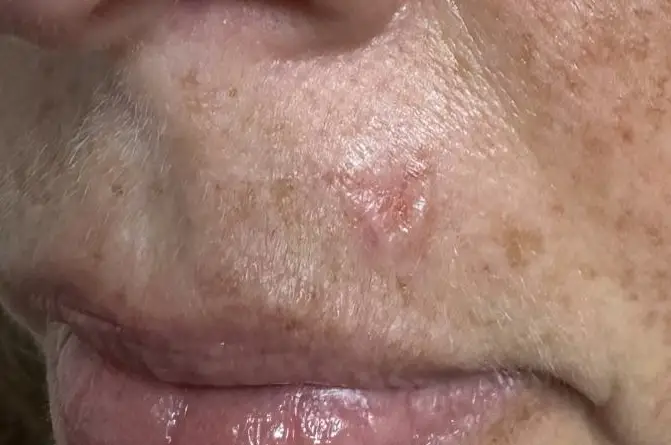
Basal Cell Carcinoma (BCC)
Basal Cell Carcinoma is the most common and least aggressive type of skin cancer. It usually appears as a small, shiny bump or a red patch on the skin.
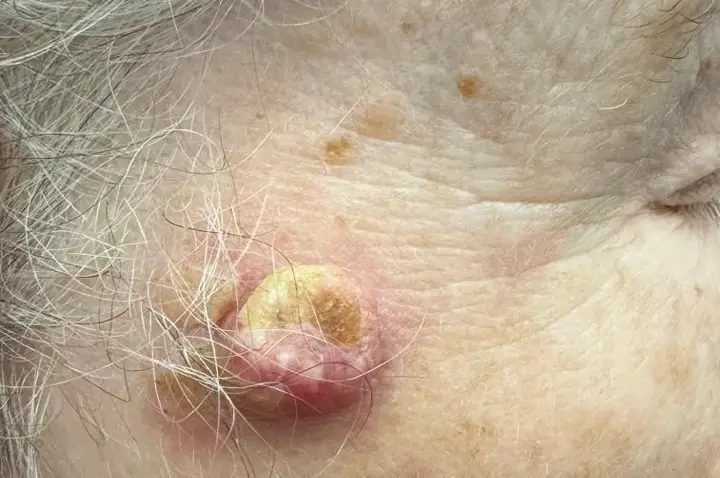
Squamous Cell Carcinoma (SCC)
Squamous Cell Carcinoma is more aggressive than BCC. It often appears as a firm, red nodule or a flat lesion with a scaly, crusted surface.
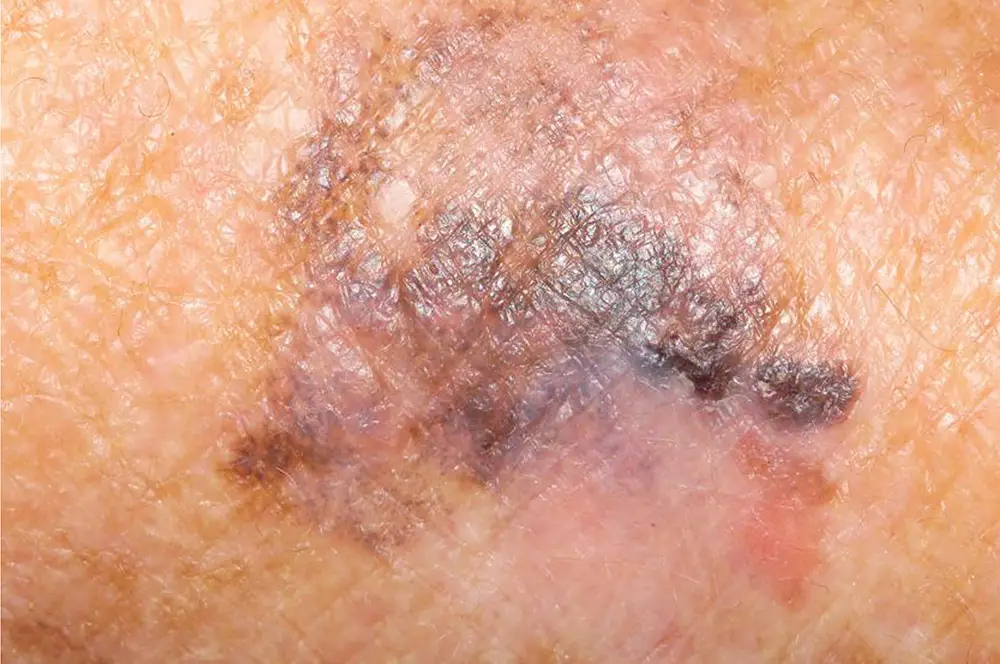
Melanoma
Melanoma is the most serious type of skin cancer. Melanoma can develop in existing moles or as new dark spots, and is more likely to spread to other parts of the body if it is not treated early.
What are the symptoms of skin cancer?
As with all cancers, early detection is vital, and understanding the early signs of skin cancer imperative.
Skin cancer symptoms vary depending on the type of skin cancer:
- A pearly or translucent bump or patch with a rolled pearly edge
- A flat bright red mark
- Bleeding or scabbing sore that may temporarily appear to heal but soon recurs in the same place
- A pale scar like change possibly with a raised edge
- A firm, red nodule, sometimes with a keratin core like a mini volcano on the skin
- A scaly crusted patch
- A brownish irregular skin lesion or patch with variation in colour with darker or lighter areas that may appear black, brown, red or blue/grey
- A mole that changes in colour, size, or shape
- Dark lesions on the palms, soles, fingertips, or toes, or on mucous membranes lining the mouth, nose, vagina, or anus
Moles and melanoma
Whilst moles are typically nothing to worry about, it is important to monitor suspicious moles as they can develop into skin cancer. You should aim to check them monthly, and we advise you to undergo mole mapping at least once a year by a professional dermatologist.
Melanoma UK recommends the ABCDE rule for monitoring your moles:
Asymmetry
One half of the mole does not match the other.
Border
Edges are irregular, ragged, or blurred.
Colour
Uneven shades of black, brown, tan, white, red, or blue.
Diameter
Larger than 4-6mm (about the size of a pencil eraser).
Evolving
Changes in size, shape, or colour over time.
Importantly, having a mole does not necessarily mean you will develop melanoma skin cancer. However, it is always better to be on the safe side and have any moles of concern checked by a professional.
How to treat skin cancer
Treatment for skin cancer depends on the type, stage, and location of the cancer, as well as the patient's overall health.
- Excisional skin surgery involves cutting out the tumour and a margin of healthy skin. This is usually done under local anaesthetic.
- Mohs surgery is a layer-by-layer removal of the skin. The surgeon removes thin layers of skin one layer at a time, examining each under a microscope to determine if any cancer remains. This procedure continues until only cancer-free tissue remains. This preserves as much of the healthy tissue as possible.
- Curettage and cautery is a treatment used to remove basal cell and squamous cell carcinomas. The procedure involves your doctor scraping the affected skin's surface with a curette (a spoon-shaped instrument or ring-shaped blade), in order to remove the cancer cells.
- Radiation therapy uses high-energy rays to target and kill cancer cells. Radiation is often used for cancers that cannot be surgically removed or larger cancers, especially in the elderly.
- Cryotherapy freezes cancer cells with liquid nitrogen. This aims to destroy the cancer cells, and is usually only suitable for small or superficial skin cancers.
- Topical treatments involve applying creams that contain anti-cancer agents directly to the skin. These are only used for superficial basal cell cancers or pre-cancerous conditions like Bowen's disease or Actinic Keratoses.
- Photodynamic therapy uses a combination of a photosensitising cream and red light or daylight. The drug containing cream is applied to the affected area for a period of time that makes cancer cells sensitive to light. After a couple of hours you return for the doctor or nurse to shine a particular type of light on the treatment area. This type of treatment is often used for actinic keratoses and superficial skin cancers.
- Immunotherapy boosts the body's immune system to fight cancer, getting your own immune system to fight the cancer cells.
- Targeted therapy is a type of cancer treatment that targets the changes in the cancer cells that help them to grow, divide, and spread.
How to prevent skin cancer
While skin cancer can occur in anyone, you can take steps to minimise the risks.
1. Use sun protection
- You should use a broad-spectrum sunscreen with an SPF of at least 30 (but ideally 50+) when outside for extended periods of time. Ensure that you wear protective clothing, hats, and sunglasses to cover your skin.
- When UV rays are strongest, typically between 11am - 3pm, you should stay in a shaded area, such as indoors or under shelter.
- It is also important to avoid regular use of sunbeds, as these use high intensity UV radiation which can damage your skin cells.
2. Undertake regular skin examinations
- It is important to examine yourself monthly to check for new or changing moles. If you are unsure or would like a second opinion, it is advised to schedule an annual skin examination with a clinical dermatologist, especially if you have risk factors for skin cancer.
3. Maintain a healthy lifestyle
- Living a healthy lifestyle is important as this lowers your risk of developing skin cancer. You should avoid smoking and excessive alcohol consumption, alongside maintaining a balanced diet rich in antioxidants.
Important information
When should I see a dermatologist for skin cancer?
You should also see a dermatologist if you are concerned about any marks on the skin that do not go away, or if you notice a mole on the skin has changed in shape or colour or started to bleed. Mole mapping with a dermatologist is recommended, at least once a year, to help combat early signs of skin cancer.
What's the first step to treating skin cancer?
If you are concerned you may have skin cancer, you should contact a medical professional. It is vital you act immediately so you have the best possible outcome, as when found early, cancers can be dealt with swiftly and effectively.
We treat those with skin cancer
At Experts in Skin and Hair, we have decades of experience treating people with skin cancers. Our team of experts are able to map your moles, giving you peace of mind, while also being able to perform mole removals and assist with surgically removing skin cancers.
Contact us today to arrange your first appointment to discuss treatment.